Finna Meaning in Text: What Does “Finna” Mean?
If someone texts you “I’m finna leave” or “Finna get some food,” they are saying they are about to do something or intend to do it soon. “Finna” is an informal slang term that generally means “fixing to,” or “about to.” It commonly appears in casual conversations, text messages, social media posts, and online chats in the United States.
For example, “I’m finna call you” means “I’m about to call you.” The word communicates an intention or an action that is expected to happen soon. Its exact meaning depends on the sentence, but it usually signals what someone plans to do next.
Although people often use finna in relaxed conversations with friends, it is not typically appropriate for formal writing. Understanding its meaning can help you follow everyday American slang without confusing it with other abbreviations or texting expressions.

What Does Finna Stand For?
“Finna” is commonly associated with the phrase “fixing to.” In this expression, “fixing to” does not mean repairing something. It means preparing or intending to do something.
For example:
- “I’m finna study.” means “I’m about to study.”
- “She finna call us.” means “She is about to call us.”
- “We finna head out.” means “We are about to leave.”
- “They finna start the game.” means “They are about to start the game.”
In casual speech, the word may appear with different sentence structures. Some speakers include a form of “be,” such as “I’m finna,” while others use “finna” directly before a verb, such as “She finna go.” The wording varies by speaker and dialect.
Finna is not an acronym, so its letters do not stand for separate words. It is a slang form that developed from spoken English.
Where Does Finna Come From?
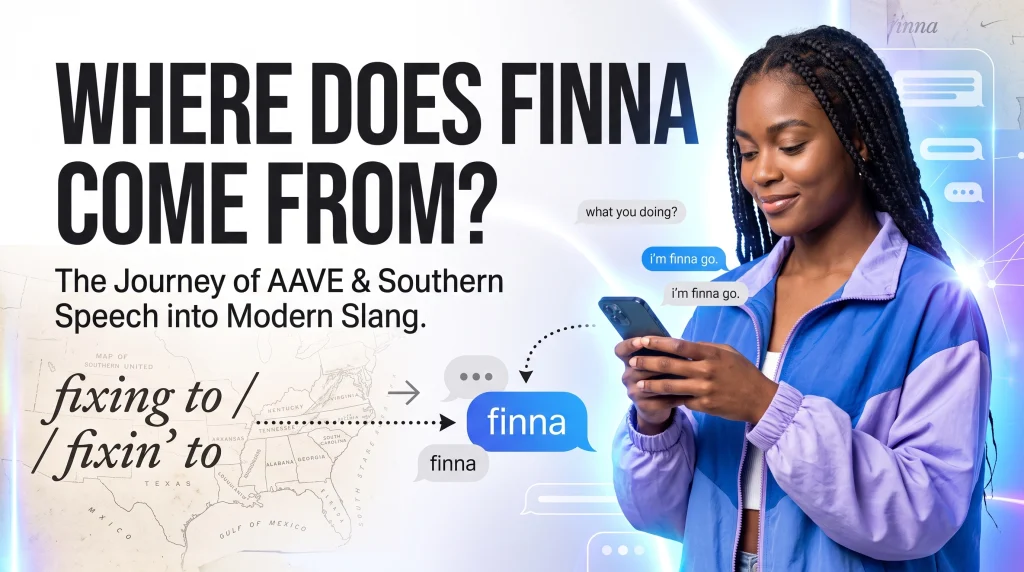
Finna developed from the spoken expression “fixing to,” which has long been used in Southern American English to describe an intended or upcoming action. The expression has also been associated with African American English, where it is a recognized part of the language variety’s grammar and vocabulary.
Over time, “fixing to” was shortened in speech to forms such as “finna.” The word later became more widely recognized through music, entertainment, online conversations, and social media.
Today, people across different parts of the United States may recognize and use finna, although its frequency and meaning in everyday speech can vary by region, community, and individual. It is more than a random internet abbreviation because it has roots in established spoken language.
Understanding this background also helps explain why finna may appear in sentences that differ from formal Standard American English. Those patterns can be natural within the dialects and speech communities that use them.
How Is Finna Used in Text Messages?
People use finna in text messages to express an intention, describe an upcoming action, or tell someone what they are about to do. It often gives a message a relaxed, conversational tone.
1. Talking About Immediate Plans
Finna is useful when someone wants to say they are about to do something.
Examples:
- “I’m finna go to bed.” means “I’m about to go to bed.”
- “Finna grab lunch.” means “I’m about to get lunch.”
- “I’m finna head home.” means “I’m about to leave for home.”
2. Making an Announcement
Someone might use finna to tell friends about a plan or upcoming event.
Examples:
- “We finna watch a movie tonight.”
- “I’m finna start my new project.”
- “They finna open the doors soon.”
These messages communicate what the sender expects or intends to happen.
3. Expressing Excitement
Finna can also appear when someone is excited about an upcoming activity.
Examples:
- “I’m finna see my favorite artist!”
- “We finna have so much fun.”
- “This weekend finna be amazing.”
In these examples, the word helps convey anticipation and an informal tone.
4. Explaining What Happens Next
In some conversations, finna signals an action that seems imminent or likely to happen soon.
Examples:
- “Hurry up, we finna miss the bus.”
- “I’m finna call you back.”
- “She finna tell everyone the news.”
The surrounding conversation helps clarify whether the action is a firm plan, an expectation, or something about to happen.
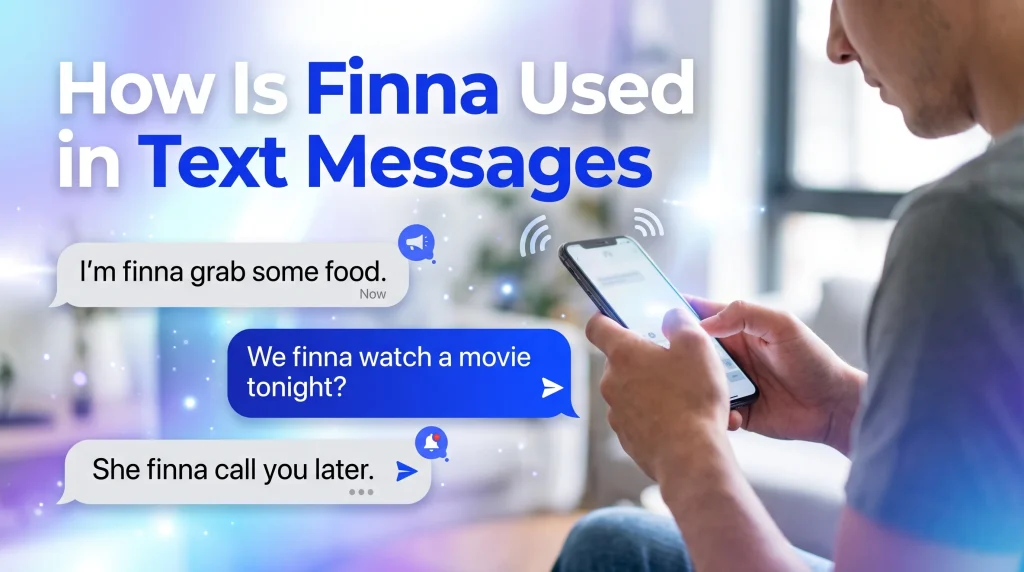
Common Examples of Finna in Texting
The following table shows how finna can appear in everyday American English conversations.
| Text message | Meaning in standard English |
|---|---|
| “I’m finna eat.” | I’m about to eat. |
| “Finna take a nap.” | I’m about to take a nap. |
| “We finna leave.” | We’re about to leave. |
| “He finna call you.” | He’s about to call you. |
| “I’m finna study for my test.” | I’m about to study for my test. |
| “They finna win this game.” | They look likely to win this game. |
| “You finna come over?” | Are you about to come over? |
| “It’s finna rain.” | It looks like it’s about to rain. |
These are illustrative examples rather than quotations from specific conversations. In actual messages, spelling, punctuation, and sentence structure may vary.
Finna vs. Gonna vs. Wanna
Finna, gonna, and wanna are informal English expressions, but they do not mean exactly the same thing. The main difference is whether someone is expressing an upcoming action, a future plan, or a desire.
| Slang | Meaning | Example |
|---|---|---|
| Finna | About to; intending to do something soon | “I’m finna leave.” |
| Gonna | Going to; expressing a future action or plan | “I’m gonna leave tomorrow.” |
| Wanna | Want to; expressing a desire | “I wanna leave early.” |
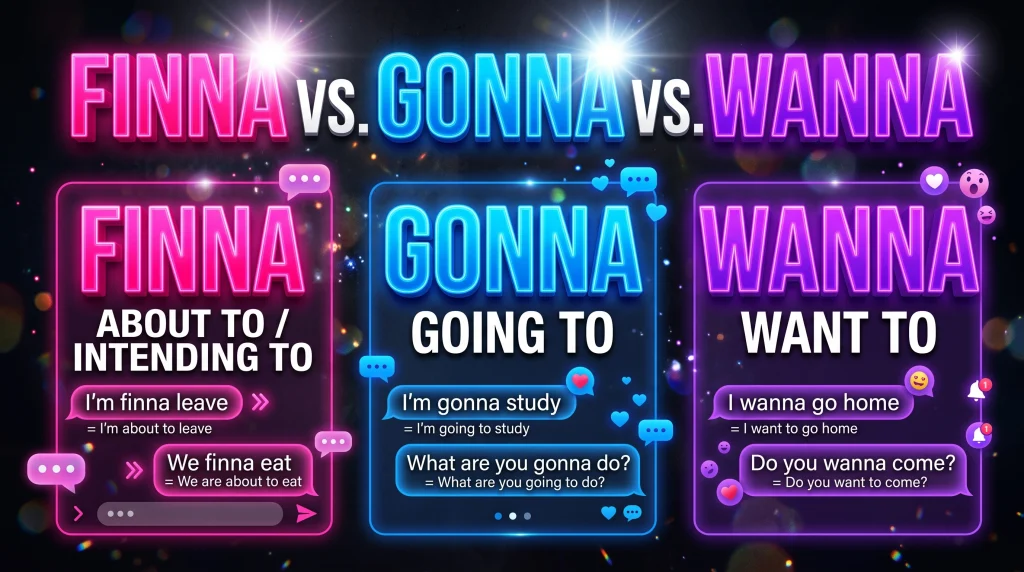
Finna vs. Gonna
Finna often emphasizes an action that is close at hand, while gonna can refer to plans further in the future. However, their meanings overlap, and the exact difference depends on context and the speaker’s dialect.
ygdp.yale.edu
+1
For example:
- “I’m finna eat” suggests the person is about to eat.
- “I’m gonna eat later” describes a future plan.
Finna vs. Wanna
Wanna expresses a desire or wish, while finna generally indicates an intended or upcoming action.
For example:
- “I’m finna go” means “I’m about to go.”
- “I wanna go” means “I want to go.”
Someone may want to do something without actually planning to do it immediately. That is the key distinction between these expressions.
Is Finna Proper English?
Finna is a recognized English slang form, not simply a spelling mistake or a random internet abbreviation. It is associated with African American English and has connections to the Southern American English expression “fixing to.” Linguistic research documents its use as a marker of the near future.
ygdp.yale.edu
+1
Whether it is appropriate depends on the setting. In casual conversations, text messages, online posts, and informal dialogue, finna can sound natural to people who use or recognize it. In formal essays, business correspondence, academic papers, and professional reports, alternatives such as “about to,” “planning to,” or “going to” are usually more suitable.
It is also important to recognize that informal dialects have their own patterns and conventions. Finna should not automatically be treated as incorrect just because it differs from formal written English.
When Should You Use Finna?
Use finna when you want to communicate an upcoming action or intention in a casual conversation and the expression feels natural for your audience.
Good situations for using finna include:
- Texting friends about your plans.
- Chatting casually with people who use similar slang.
- Writing informal social media captions.
- Reproducing natural dialogue in a fictional conversation.
Avoid using finna when:
- Writing a formal school assignment that requires standard academic English.
- Sending a professional email or business proposal.
- Communicating with someone who may not understand the expression.
- You need a precise, formal description of a future plan.
For example, you could text a friend, “I’m finna head out,” but write “I’m about to leave” in a formal message.
Does Finna Mean the Same Thing on Social Media?
Generally, yes. On platforms such as TikTok, Instagram, Snapchat, and other messaging services, finna usually carries the same meaning as it does in everyday informal speech: “about to,” “going to,” or “intending to do something soon.”
Examples include:
- “Finna post a new video.”
- “I’m finna log off.”
- “We finna have a good time.”
- “Bro finna win this challenge.”
The tone can change depending on the context. A message might sound excited, humorous, confident, or matter-of-fact. Finna itself does not automatically make a message sarcastic, rude, or romantic.
If you see the word in a caption or comment, read the full sentence to understand the intended meaning.
Conclusion
Finna meaning in text is simple: it generally means “about to” or “fixing to,” expressing an intention or action expected in the near future. It is a well-established informal expression associated with African American English and Southern American English, and it is widely recognized in online conversations.
The easiest way to understand it is to replace finna with “about to” and see whether the sentence still makes sense. Remember that finna and gonna can overlap, while wanna specifically expresses a desire. Knowing these differences makes casual American texting easier to understand.
FAQs About Finna Meaning in Text
1. What does finna mean in a text message?
Finna means “about to” or “going to do something soon.” For example, “I’m finna sleep” means “I’m about to go to sleep.”
2. What does finna stand for?
Finna is not an acronym. It is a shortened form associated with “fixing to,” an expression used to communicate preparation or intention.
3. Is finna the same as gonna?
They have similar meanings, but they are not always interchangeable. Finna often suggests an action is imminent, while gonna can describe plans for a more distant future.
4. Is finna rude or offensive?
Finna is not inherently rude or offensive. Its tone depends on the surrounding words and situation, just as it does with other informal expressions.