DPWM Meaning in Texting: What Does DPWM Mean in a Text?
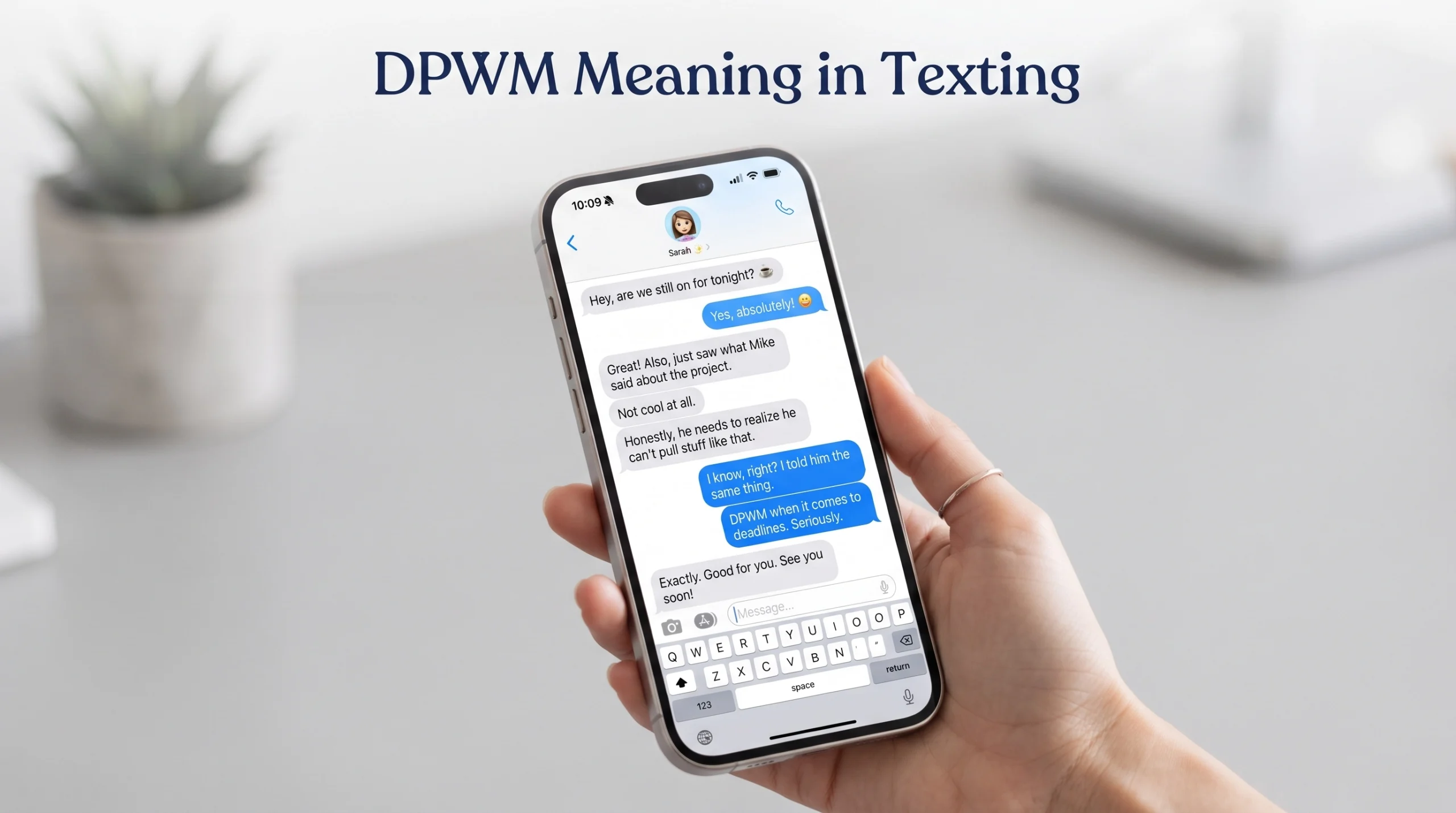
If you received a message containing DPWM, the abbreviation may be confusing at first. In casual texting and online conversations, DPWM usually means “Don’t Play With Me.” People use it when they want someone to stop joking, teasing, messing around, or treating a situation as if it is not serious.
The tone can change considerably depending on the conversation. A friend might write “DPWM 😂” after hearing surprising news as a playful way of saying, “Are you serious?” In a more serious conversation, “DPWM” can communicate that the sender wants to be taken seriously.
What Does DPWM Stand For?
DPWM stands for “Don’t Play With Me.”
Each letter represents a word:
| Letter | Word |
|---|---|
| D | Don’t |
| P | Play |
| W | With |
| M | Me |
The phrase is an informal abbreviation used primarily in casual digital communication. It comes from the everyday expression “Don’t play with me,” rather than having a single documented inventor or official origin. Current slang references consistently identify “Don’t Play With Me” as the common texting interpretation.
Depending on the situation, DPWM can communicate ideas such as:
- “Stop joking with me.”
- “Be serious.”
- “Don’t mess with me.”
- “Are you serious right now?”
- “Don’t test me.”
- “I’m not joking.”
What Does DPWM Mean in a Text?
In a text message, DPWM usually tells the other person to stop playing around or to take the sender seriously. It can be a reaction to teasing, surprising information, disbelief, or something the sender considers important.
For example:
Friend 1: “I just bought us tickets for the concert.”
Friend 2: “DPWM 😭”
Here, DPWM probably expresses excitement and disbelief rather than anger. The sender may essentially mean, “You’re serious?” or “Don’t tell me you’re joking!”
Now consider a different situation:
Person 1: “I told you I was serious about this.”
Person 2: “DPWM.”
The second example sounds firmer because there is no playful context or emoji. The sender appears to be emphasizing that they do not want the other person to joke around.
This is why context is important when interpreting DPWM. The abbreviation itself stays the same, but the emotion behind it can change.

How Is DPWM Used in Conversations?
People generally use DPWM in informal conversations with friends, relatives, classmates, or people they communicate with casually. It can appear as a complete response or as part of a longer message.
As a playful reaction
Someone may use DPWM when a friend says something surprising or unbelievable.
Example:
“Wait, you actually met your favorite singer? DPWM 😂”
Here, the phrase is probably playful and expresses disbelief.
To show seriousness
DPWM can also emphasize that someone is not joking.
Example:
“DPWM, I really need you to listen.”
The surrounding sentence makes the intended tone much clearer.
When someone feels teased
A person may use DPWM when another person keeps joking about them.
Example:
“You keep bringing up that embarrassing photo. DPWM 😭”
In this case, the message may be humorous while still asking the other person to stop.
When reacting to unexpected news
DPWM can also be used after hearing something surprising.
Example:
“You got tickets for tomorrow? DPWM!”
The sender may be expressing excitement and disbelief rather than making a serious warning.
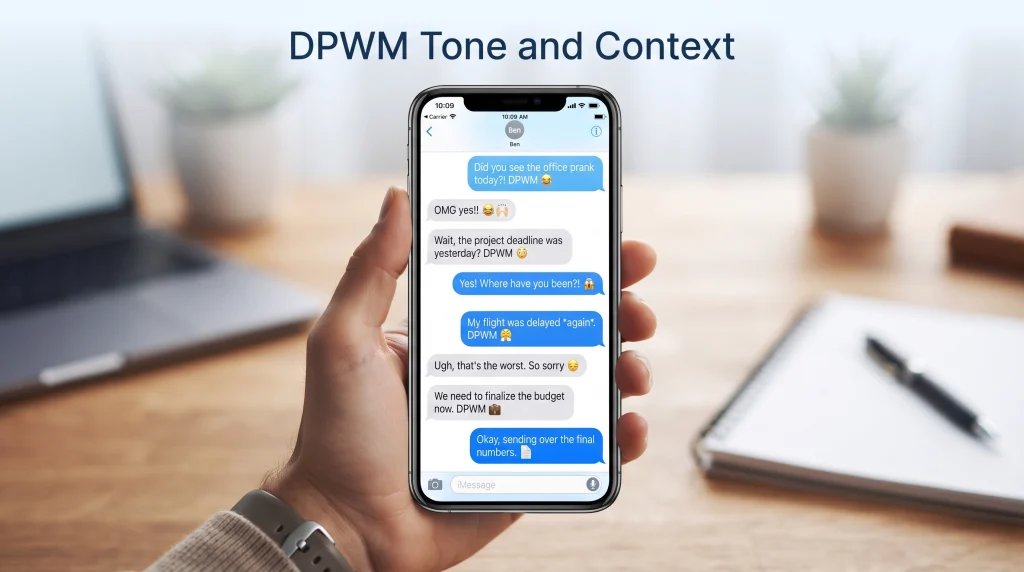
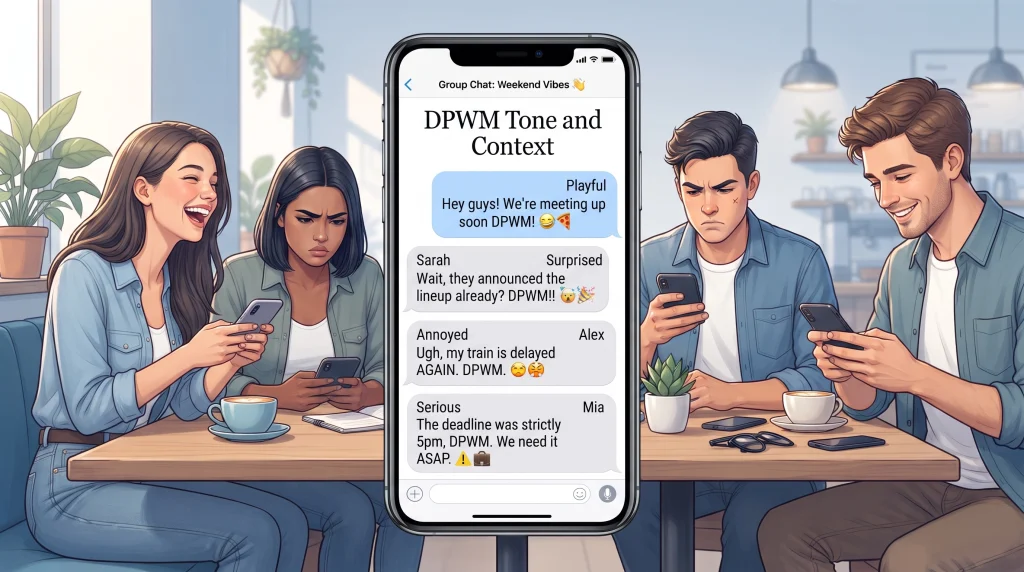
DPWM Tone and Context
One of the most important things to understand about DPWM meaning in texting is that it does not always sound the same.
| Context | Likely tone | Possible meaning |
|---|---|---|
| Friend makes a joke | Playful | “Stop messing with me!” |
| Someone gives surprising news | Excited or shocked | “Are you serious?” |
| Someone keeps teasing | Annoyed | “Stop joking around.” |
| Serious disagreement | Firm | “Take me seriously.” |
| Message with laughing emojis | Lighthearted | “You can’t be serious!” |
| Message with no emoji and short punctuation | Firm | “Don’t test me.” |
Emojis, punctuation, previous messages, and the relationship between the people can all provide clues about the intended tone. Several current explanations of DPWM emphasize that the same abbreviation can sound playful or serious depending on context.
Examples of DPWM in Text Messages
Here are some natural examples of how DPWM may appear in casual conversations.
Example 1: Surprise
“I actually won the giveaway.”
“DPWM 😭”
Meaning: “Seriously? I can’t believe it!”
Example 2: Teasing
“I’m telling everyone about your karaoke performance.”
“DPWM 😂”
Meaning: “Stop messing with me!”
Example 3: Serious conversation
“I need you to understand that I’m serious. DPWM.”
Meaning: “Don’t treat what I’m saying as a joke.”
Example 4: Unexpected plan
“We’re leaving for the beach tomorrow morning.”
“DPWM!”
Meaning: “Are you actually serious?”
Example 5: Friendly disbelief
“I ate the last slice of pizza.”
“DPWM 😭”
Meaning: “You have got to be kidding me.”
These examples show why translating DPWM into one fixed emotional meaning can be misleading. The basic phrase is “Don’t Play With Me,” but the intended message may range from joking disbelief to genuine seriousness.
DPWM on Social Media
DPWM can also appear in social media comments, direct messages, captions, and casual online conversations. Current slang references report usage across platforms such as TikTok, Instagram, Snapchat, and other messaging environments.
On social media, the abbreviation can be especially expressive because users often combine it with emojis, punctuation, images, or reactions.
For example:
“You really did that? DPWM 😭”
The crying emoji can make the expression feel humorous or dramatically surprised.
By contrast:
“DPWM.”
A short message without an emoji can feel more direct or serious. However, you should not determine someone’s attitude from the abbreviation alone. The surrounding conversation provides better evidence.
How to Respond to DPWM
The best response depends on what the sender appears to mean.
If they are joking, you can respond casually:
“I’m serious 😂”
If they seem surprised:
“Yes, seriously!”
If they appear annoyed:
“Okay, I’m not trying to mess with you.”
If you cannot tell what they mean, asking for clarification is perfectly reasonable:
“Wait, what do you mean?”
The relationship and previous conversation matter more than the acronym itself. If DPWM appears during a serious disagreement, responding calmly and directly is usually clearer than continuing the joke.
DPWM vs. Similar Texting Expressions
DPWM can overlap in meaning with several informal expressions, but they are not identical.
| Expression | Common meaning | Typical use |
|---|---|---|
| DPWM | Don’t Play With Me | Telling someone to stop joking or take something seriously |
| FR | For Real | Emphasizing sincerity or asking whether something is true |
| WYLL | What You Look Like | Asking about someone’s appearance |
| SMH | Shaking My Head | Showing disappointment, disbelief, or annoyance |
| IDK | I Don’t Know | Expressing uncertainty |
| NGL | Not Gonna Lie | Introducing an honest statement |
DPWM is more directly connected to the idea of not joking around or not testing someone’s patience. FR, for example, is more commonly used to emphasize that something is genuine or to ask whether another person is being serious.
Can DPWM Have Other Meanings?
Yes. Although “Don’t Play With Me” is the common interpretation in casual texting, the abbreviation can have other meanings outside slang.
In engineering and power electronics, DPWM can mean “Discontinuous Pulse Width Modulation.” It refers to a type of pulse-width modulation in which switching is intentionally interrupted during portions of a cycle. Technical sources describe DPWM as a method used in power converters and inverters, including approaches designed to reduce switching losses.
Therefore, context matters:
- Text message: Usually “Don’t Play With Me”
- Social media chat: Usually “Don’t Play With Me”
- Engineering document: May mean “Discontinuous Pulse Width Modulation”
- Technical discussion: Do not assume the slang definition
If you see DPWM in an ordinary conversation between friends, the texting meaning is generally the relevant one. If you see it in an engineering or academic setting, look at the surrounding terminology before interpreting it.
When Not to Use DPWM
DPWM is informal slang, so it is generally better suited to casual communication than professional writing.
For example, using DPWM with a close friend may feel natural:
“DPWM 😂 You actually did that?”
But in a workplace email, school assignment, formal request, or professional document, writing the full idea is clearer.
Instead of:
“DPWM.”
A professional message could say:
“I’m serious about this request, so please take it seriously.”
Using the full phrase also reduces the possibility that someone unfamiliar with the abbreviation will misunderstand you.
Conclusion
The DPWM meaning in texting is usually “Don’t Play With Me.” It is an informal abbreviation used to tell someone to stop joking, stop teasing, take something seriously, or avoid messing around.
The exact tone depends on context. DPWM can sound playful when combined with laughing or crying emojis, but it can also sound firm during a serious conversation. If the surrounding messages do not make the meaning clear, asking the sender is safer than assuming their intention.
Remember that DPWM can also have technical meanings, particularly Discontinuous Pulse Width Modulation in engineering. The conversation or subject area should always guide your interpretation.
FAQ
What does DPWM mean in texting?
DPWM usually means “Don’t Play With Me.” It is used when someone wants another person to stop joking, teasing, or treating a situation lightly.
What does DPWM mean on social media?
On social media, DPWM generally means “Don’t Play With Me.” Depending on the post or conversation, it can express playful disbelief, surprise, annoyance, or seriousness.
Is DPWM rude?
Not necessarily. DPWM can be playful between friends, especially when paired with emojis. In a serious conversation, however, it can sound firm or annoyed.