
What Does “Mean in Text” Really Mean?
When people search “mean in text really mean,” they are usually trying to understand what a word, phrase, or message actually means in a texting conversation. The question is not always about a dictionary definition. Often, it is about the sender’s intent, tone, emotion, or implied message.
Texting can make this difficult because written messages do not include the same vocal tone, facial expressions, or body language that people use in face-to-face conversations. As a result, a simple message such as “okay,” “sure,” or “fine” can be interpreted in several ways depending on the situation.
Understanding what someone means in text therefore requires more than reading the individual words. The surrounding conversation, punctuation, emojis, timing, relationship between the people, and previous messages can all provide useful context.
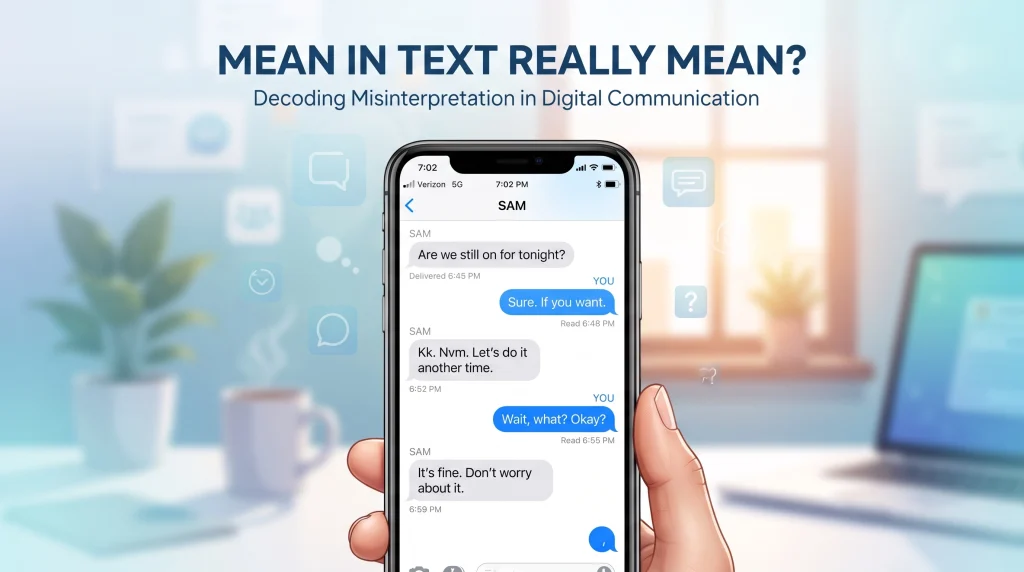
What Does “Mean in Text” Really Mean?
The phrase “mean in text” generally refers to the intended meaning of a word, phrase, abbreviation, emoji, or message when it is used in a text conversation.
For example, if someone asks, “What does ‘fine’ mean in text?” they might want to know whether “fine” means genuine agreement, frustration, reluctance, or something else.
Likewise, if someone writes, “What does ‘LOL’ mean in text?” they are asking about the meaning of a particular texting expression. If they ask, “What did she mean by ‘okay’?” they are more likely asking about tone and intent.
This distinction is important because the literal definition of a word does not always explain how it functions in a real conversation.
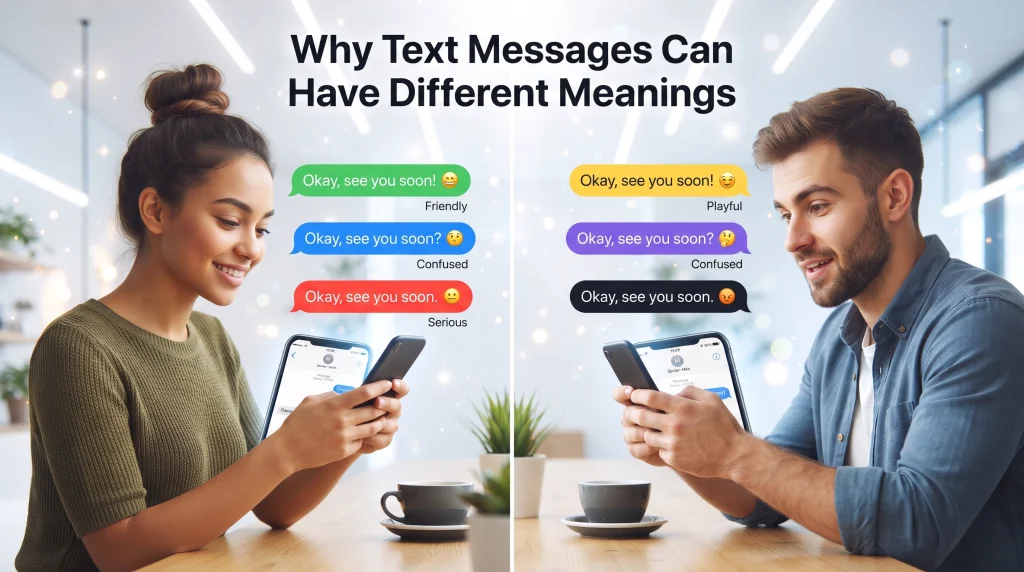
Why Text Messages Can Have Different Meanings
Texting removes many communication signals that are available during an in-person conversation. You cannot hear whether someone sounds excited, annoyed, sarcastic, nervous, or sincere unless they make that tone clear through their words or other signals.
That is why a short message can sometimes feel ambiguous.
For example:
“Okay.”
Depending on the conversation, this could simply mean agreement. It could also feel serious or distant to the recipient.
On the other hand:
“Okay!! 😊”
The additional punctuation and emoji can make the same basic word appear more enthusiastic or friendly.
Research and reference guides discussing digital communication commonly point to context, punctuation, capitalization, message length, and other textual signals as factors that can affect how a message is interpreted.
Literal Meaning vs. Intended Meaning in Texts
A useful way to understand texting is to separate literal meaning from intended meaning.
Literal meaning
Literal meaning is what the words normally mean according to standard language.
For example:
“I am tired.”
Literally, the person is saying they feel tired.
Intended meaning
The intended meaning is what the person is trying to communicate through those words in that particular situation.
For example:
“I’m tired.”
If someone sends this while you are asking them to go out, they might simply be explaining why they cannot go. If they send it during an argument, it could also communicate that they are emotionally or mentally exhausted.
The words remain the same, but the surrounding context changes how the message should be understood.
How Tone Changes the Meaning of a Text
Tone is one of the biggest reasons people wonder what a text really means.
Consider these examples:
| Text | Possible tone |
|---|---|
| “Sure” | Neutral agreement |
| “Sure!” | Enthusiastic agreement |
| “Sure.” | Could feel more serious or reserved |
| “sure lol” | Casual or playful |
| “SURE” | Could indicate strong emphasis or excitement |
These are not fixed rules. A period does not automatically mean someone is angry, and capital letters do not automatically mean someone is upset. The sender’s normal texting style matters.
For example, if a person always uses periods at the end of their messages, the punctuation probably carries less emotional information than it would from someone who normally sends informal messages without punctuation.

How Punctuation Affects Text Meaning
Punctuation can influence how a message is perceived because text does not provide vocal tone.
Compare:
“Really?”
“Really!”
“Really.”
“Really”
All four contain the same basic word, but they can create different impressions.
A question mark can suggest curiosity or disbelief. An exclamation mark can add excitement or emphasis. A period can make a short response feel more final or serious to some readers.
However, punctuation should not be treated as a universal code. Different people have different texting habits, and the meaning of punctuation depends on the person and conversation.
What “Mean” Can Refer to in a Text
When someone asks what something “means” in a text, they could be asking about several different things.
The dictionary definition
They may simply want to know what a word means.
For example:
“What does ‘sarcastic’ mean?”
This is a vocabulary question.
A slang definition
They may have encountered an abbreviation or slang expression.
For example:
“What does RLY mean in text?”
RLY is commonly used online as an abbreviation for “really.”
Emotional tone
They may want to know how a message sounds.
For example:
“Why did he just say ‘k’?”
The question is not necessarily about the definition of “k.” It is about what the short response may communicate in that conversation.
Hidden or implied intent
Sometimes people want to know what a person was trying to communicate without saying directly.
For example:
“Can we talk?”
The literal meaning is straightforward, but the sender may be signaling that they want a more serious conversation. The actual reason cannot be determined from those words alone.

Examples of Different Meanings in Text Messages
Context can make a major difference.
Example 1: “Fine”
“Fine.”
This could be genuine agreement, frustration, reluctance, or simply a person’s normal way of responding.
Example 2: “Haha”
“Haha”
It could indicate genuine amusement, polite acknowledgment, or an attempt to keep the conversation light.
Example 3: “Really?”
“Really?”
This could express curiosity, surprise, disbelief, or skepticism.
Example 4: “Okay”
“Okay.”
It could mean the person understands or agrees. If the conversation has been tense, the same response may be perceived as more serious or distant.
Example 5: “LOL”
“LOL, that’s funny.”
Here, LOL directly signals a lighthearted response. It is commonly used online as shorthand for “laughing out loud,” although people also use it as a conversational marker without literally laughing.
These examples show why there is rarely one guaranteed interpretation for a short message.
How to Understand What Someone Really Means
When a text seems confusing, avoid interpreting one word in isolation. Instead, consider the entire conversation.
Read the messages before and after it
The surrounding messages often provide the strongest clue. A response that looks cold by itself may make perfect sense when you read what came before it.
Consider the person’s usual texting style
Some people send short messages to everyone. Others write long messages and frequently use emojis. Comparing the message with their normal communication style can help provide context.
Look at punctuation and emojis
Capitalization, punctuation, emojis, GIFs, and other visual elements can provide additional clues, but they should not be treated as definitive proof of someone’s feelings.
Consider the relationship
A message from a close friend may have a different meaning from the same message sent by a coworker, classmate, or family member.
Avoid assuming intent
A text message rarely provides enough information to know exactly what another person is thinking. If the meaning is important and genuinely unclear, asking for clarification is often more reliable than guessing.
Does “Mean in Text” Have a Slang Meaning?
The phrase “mean in text” is not itself a standard slang abbreviation. It is generally a search-style phrase people use when they want to understand the meaning or intent behind something written in a text message. Current online guides similarly describe “mean in text” as a question about the definition, tone, context, or intended message behind digital communication.
It is therefore different from a texting abbreviation such as RLY, which has a specific shorthand meaning: “really.”
Why Context Matters More Than a Single Word
The same word can communicate different things in different situations.
Imagine someone says:
“That’s great.”
After hearing good news, this may be sincere enthusiasm.
But if the conversation is an argument and the phrase is sent without additional context, the recipient might interpret it differently.
That does not mean the second interpretation is automatically correct. It simply shows why context is essential when interpreting digital communication.
The safest approach is to consider the complete conversation rather than assigning a fixed emotional meaning to one word.
How to Avoid Misunderstanding Text Messages
If you are unsure about a message, take a moment before reacting.
First, read the entire conversation. Then consider the sender’s normal communication style and whether anything happened immediately before the message. Look at punctuation, emojis, capitalization, and wording for additional clues, but avoid treating any single signal as definitive.
Most importantly, distinguish between what the message literally says and what you think the sender intended. Those two things are not always identical.
If the issue matters, a simple clarification such as “What did you mean by that?” can prevent an unnecessary misunderstanding.
Conclusion
So, what does “mean in text” really mean? In most cases, it refers to understanding the meaning, tone, intent, or context behind a word or message in digital communication.
Text messages can be difficult to interpret because they lack many of the signals people normally use during face-to-face conversations. Punctuation, emojis, capitalization, wording, timing, relationship history, and the surrounding conversation can all influence how a message is understood.
There is no universal rule that tells you exactly what every short text means. The most accurate interpretation usually comes from looking at the whole conversation and considering the sender’s usual communication style.
FAQ
What does “mean in text” really mean?
“Mean in text” usually refers to the intended meaning, tone, or context of a word, phrase, abbreviation, or message written in a text conversation.
Does “mean in text” refer to slang?
Not necessarily. People may use the phrase when asking about slang, abbreviations, literal definitions, emotional tone, or the intent behind a message.
Why can one text have different meanings?
Text messages often lack vocal tone, facial expressions, and body language. As a result, context, punctuation, emojis, and wording can influence how the message is interpreted.
Does punctuation change the meaning of a text?
Punctuation can affect how a message feels, especially in short messages. However, punctuation does not have one universal emotional meaning, so it should always be considered alongside the sender’s normal texting style and the broader conversation.
What does RLY mean in text?
RLY is a common internet and texting abbreviation for “really.” It can be used to emphasize a statement or express surprise or disbelief, depending on context.


