TLDR Meaning in Text: What Does TLDR Mean?
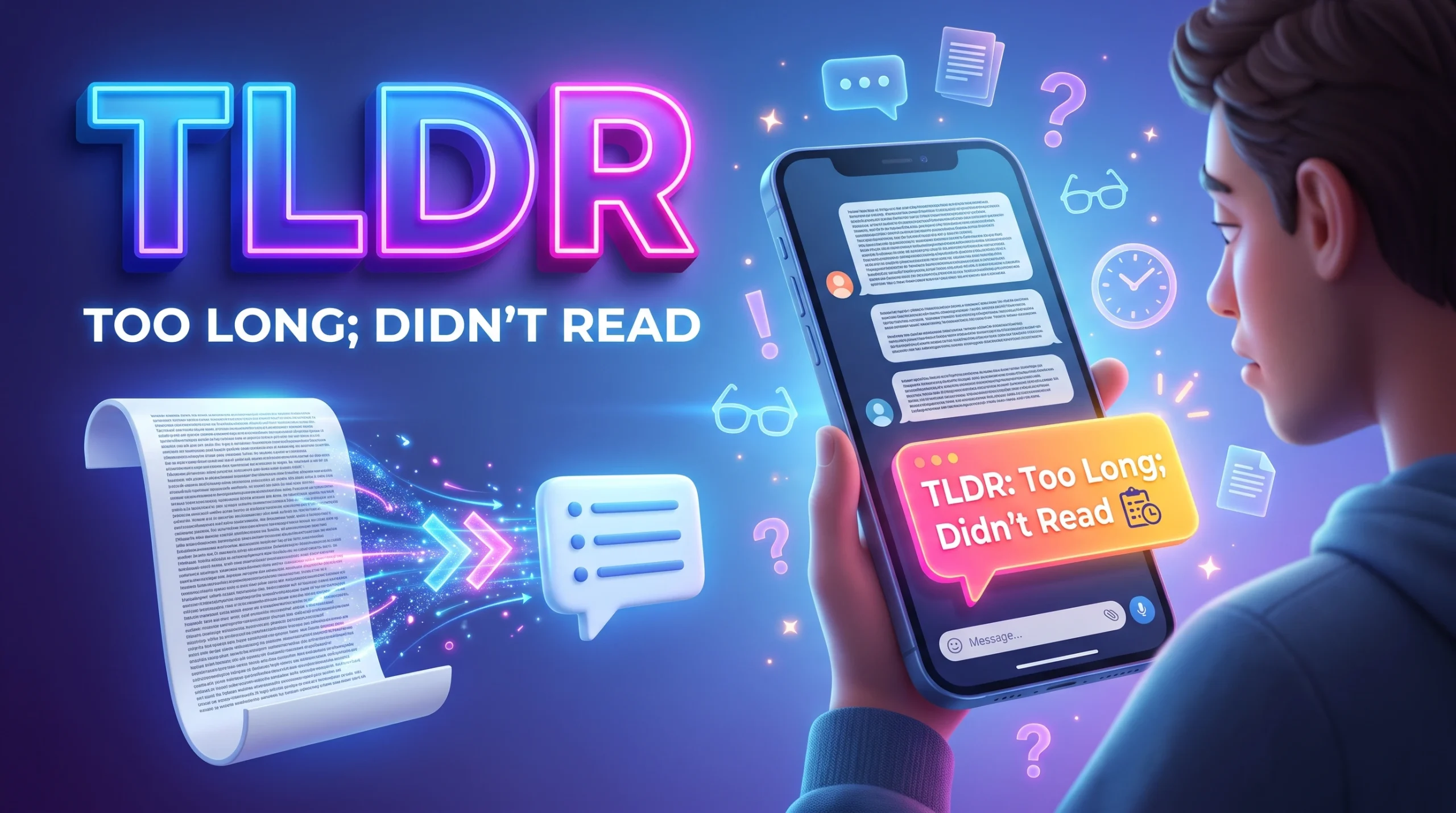
TLDR means “too long; didn’t read.” In text messages, online chats, and social media, people use it when a message or post is too long to read in full. It can also introduce a short summary of a longer explanation, article, or discussion. The tone depends on the context: TLDR can sound dismissive when directed at someone’s message, but it can be helpful when used to summarize information.
For example, someone might text, “TLDR: I can’t come tonight because I have to work.” The opening abbreviation tells the reader that the main point follows in a shorter form.
TLDR is also written as TL;DR, tl;dr, or TL;DR. These versions generally have the same meaning. The abbreviation is common in digital communication, including text messages, online forums, and social media posts.
English meaning – Cambridge Dictionary+2
What Does TLDR Stand For?
TLDR stands for “too long; didn’t read.” The phrase originally expresses that someone did not read a lengthy piece of writing because it seemed too long. Over time, it also became a label for a brief summary of the most important points.
There are two common ways to use it:
- As a reaction: Someone uses TLDR to say they skipped or did not read a long message.
- As a summary label: Someone writes “TLDR:” before giving the key takeaway from a longer explanation.
For example:
As a reaction:
“Did you read the whole post?”
“TLDR, sorry.”
As a summary:
“TLDR: The meeting has been moved to Friday at 10 a.m.”
The second use is often more considerate because it helps people understand the main point without reading every detail.
How Is TLDR Used in Texting?
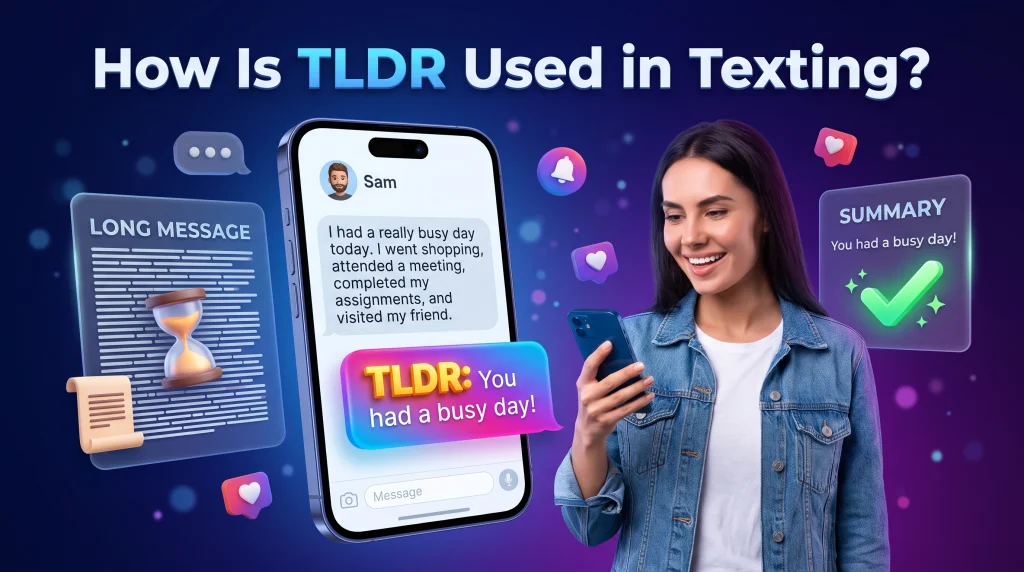
In texting, TLDR is a shortcut for talking about a long message or getting to the main point quickly. Its meaning can change slightly depending on who sends it and how it is phrased.
1. Asking for a Short Summary
People may ask “What’s the TLDR?” when they want the main idea without reading a long explanation.
Example:
Friend: “I wrote a huge message explaining everything that happened at work today.”
You: “What’s the TLDR?”
Here, the question means, “Can you give me the short version?”
2. Summarizing a Long Message
You can use TLDR before a brief explanation of something you have already discussed in detail.
Example:
“TLDR: I checked the prices, and the cheaper plan is better for what we need.”
This use is practical in group chats, family conversations, and messages involving several details.
3. Saying a Message Was Too Long
When someone responds with just “TLDR,” they may be saying they did not read the message because it was too lengthy.
Example:
Person A: “Here are all 15 reasons we should change our weekend plans…”
Person B: “TLDR 😂”
Depending on their relationship, this could be playful teasing or an impatient response. If the message was serious or personal, it may come across as rude.
TLDR Meaning on Social Media
TLDR has the same basic meaning across social media platforms, but its use depends on the type of content and conversation.
TLDR on Reddit
On Reddit, TLDR is often used to summarize a long post, story, debate, or explanation. A person may add a short summary at the end of a detailed post so readers can quickly understand the main point.
For example:
“TLDR: I tried three different budget laptops, and the second one offered the best value.”
It can also appear in comments as a reaction to a lengthy post. In that situation, the tone may be neutral, joking, or dismissive.
TLDR on TikTok and Instagram
On TikTok and Instagram, TLDR can appear in captions, comments, direct messages, and discussions about longer stories or explanations. Someone might use it to ask for the main point of a complicated caption or to summarize a situation in a comment.
For example:
“TLDR: They broke up because they wanted different things.”
The abbreviation is not limited to any one platform. It is simply a convenient way to refer to a short version of a longer explanation.
TLDR in Online Articles and Forums
Writers sometimes place a TLDR section near the beginning or end of a long article, guide, or forum post. It gives readers a quick overview before they commit to reading the full content.
A summary at the beginning can help readers decide whether the article answers their question. A summary at the end can reinforce the main takeaway.
Is TLDR Rude or Helpful?
TLDR can be either rude or helpful. The key difference is whether someone uses it to dismiss another person’s message or to make information easier to understand.
| How it is used | Likely meaning | Possible tone |
|---|---|---|
| “TLDR.” as a reply to a long personal message | I did not read all of that | Dismissive or rude |
| “What’s the TLDR?” | Please give me the short version | Neutral or casual |
| “TLDR: The event starts at 6 p.m.” | Here is the main point | Helpful |
| “TLDR 😂” among close friends | That was too much to read | Playful or teasing |
If someone sends you a long message about a serious issue, replying with only “TLDR” may make them feel ignored. A more considerate response would be, “I haven’t had time to read all of this yet. Can you tell me the main point?”
When you use TLDR to summarize your own writing, it is generally easier to interpret as helpful. When you use it to comment on someone else’s writing, consider your relationship and the subject of the conversation.
TLDR vs. TL;DR: Is There a Difference?
No. TLDR and TL;DR generally mean the same thing. The semicolon in TL;DR separates the words in the original phrase, “too long; didn’t read.”
You may see several versions online:
- TLDR
- TL;DR
- tl;dr
- tldr
All are commonly understood as the same abbreviation. There is no need to worry about using the semicolon in a casual text message. Choose the version that feels natural for the conversation.
When writing a formal article or guide, TL;DR is a recognizable form, but consistency matters more than choosing one version over another.
TLDR vs. LOL, BTW, and Other Text Abbreviations
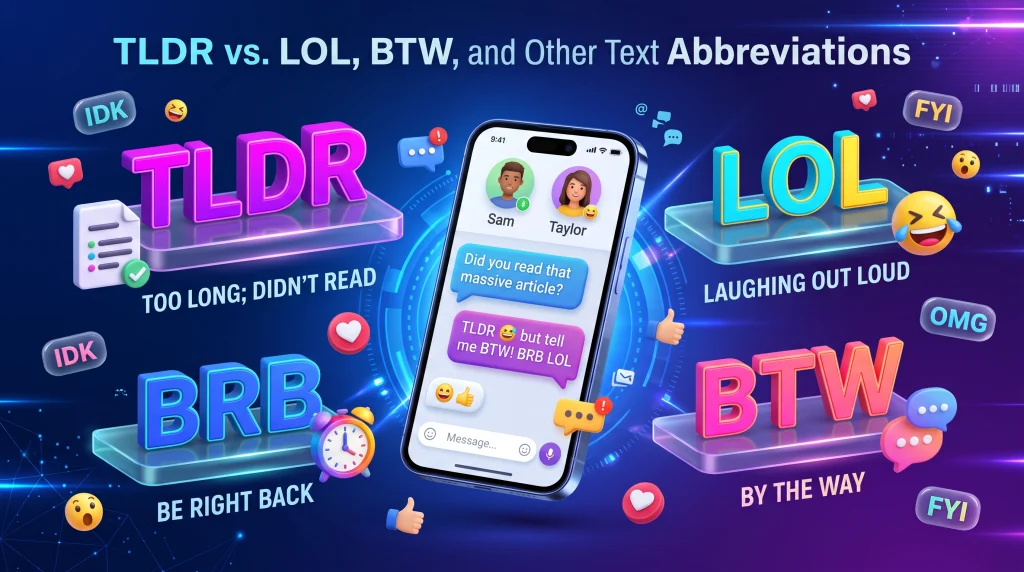
TLDR is different from many other texting abbreviations because it refers to the length of a message or a summary rather than an emotion or a general conversation phrase.
| Abbreviation | Full meaning | Common use |
|---|---|---|
| TLDR | Too long; didn’t read | Referring to a long message or its summary |
| LOL | Laughing out loud | Showing amusement |
| BTW | By the way | Adding another point |
| TBH | To be honest | Introducing an honest opinion |
| IMO | In my opinion | Sharing a personal view |
| FYI | For your information | Sharing useful information |
| IYKYK | If you know, you know | Referring to an inside joke or shared context |
For example, “LOL, that was funny” expresses amusement, while “TLDR: The movie was good, but the ending was confusing” summarizes a longer opinion.
Knowing the difference makes online conversations easier to follow, especially when several abbreviations appear in the same message.
How to Respond When Someone Says TLDR
Your response should depend on whether the person is asking for a summary, joking about a long message, or saying they did not read what you sent.
Here are some natural replies:
- “Here’s the short version.” Use this when someone wants a summary.
- “No problem, I’ll summarize it.” A friendly response that keeps the conversation moving.
- “Basically, I was saying we should leave earlier.” Get straight to the main point.
- “Haha, fair enough 😂” Works when a friend is joking about your long message.
- “It was important to me, so I’d appreciate it if you read it.” Use this when the message concerns something serious.
If you are unsure what the other person means, ask, “Do you want the short version?” This avoids misunderstandings without making the conversation awkward.
How to Use TLDR Naturally
Use TLDR when you want to refer to a long explanation or provide a shorter version of something. It works best in informal digital conversations and online writing.
Good examples:
- “TLDR: We should book the tickets today.”
- “Can someone give me the TLDR of this discussion?”
- “TLDR: The update fixes the main issue but changes a few settings.”
- “I missed the group chat earlier. What’s the TLDR?”
- “TLDR: We’re meeting at my place instead.”
A few things to keep in mind:
- Put “TLDR:” before your summary when you want readers to notice the main point.
- Keep the summary short enough to understand quickly.
- Avoid using it alone in response to a serious or emotional message if you do not want to sound dismissive.
- Remember that TLDR is informal, so spell out your meaning when communicating with someone who may not know internet slang.
A useful TLDR summary should preserve the important information rather than simply remove words. If the original message includes a deadline, decision, or essential detail, include it in the short version.
Frequently Asked Questions About TLDR
What does TLDR mean in a text message?
TLDR means “too long; didn’t read.” In a text message, it can mean someone skipped a lengthy message or wants a shorter explanation. It can also introduce a brief summary.
What does TLDR mean from a girl or a guy?
The abbreviation has the same meaning regardless of who sends it. A person may be asking for a summary, joking about a long message, or expressing that they did not read everything. The surrounding conversation helps determine the intended tone.
Does TLDR mean the same as a summary?
Not exactly. TLDR is short for “too long; didn’t read,” but it is also commonly used as a label for a summary. When someone writes “TLDR:” followed by a sentence, that sentence usually gives the main point of a longer message.
English meaning – Cambridge Dictionary+1
Is TLDR slang?
Yes. TLDR is an informal internet abbreviation used in text messages, online discussions, social media, and other digital communication. It is not usually necessary in formal writing.
Is TLDR rude?
It can be. Sending only “TLDR” in response to someone’s long or personal message may sound dismissive. However, asking “What’s the TLDR?” or adding a helpful summary is generally more neutral.
What is the difference between TLDR and TL;DR?
There is no meaningful difference in everyday usage. Both forms stand for “too long; didn’t read.” The semicolon is simply part of one common written form.
How do you pronounce TLDR?
People commonly pronounce it by saying the letters “T-L-D-R.” Some speakers use a quicker, blended pronunciation, but saying the individual letters is clear and widely understandable.
Oxford Learner’s Dictionaries+1
What does “What’s the TLDR?” mean?
It means “What’s the short version?” or “What is the main point?” Someone is asking you to summarize a longer message, story, article, or discussion.
Can I use TLDR at the beginning of a message?
Yes. You can place TLDR at the beginning when you want to give readers the main point first. For example: “TLDR: The event is postponed until Saturday.” You can also use it at the end of a longer explanation.
What is the difference between TLDR and LOL?
TLDR refers to a long message or a short summary, while LOL means “laughing out loud” and is commonly used to express amusement. The two abbreviations serve different purposes in a conversation.
Conclusion
TLDR means “too long; didn’t read,” and it has two common uses in digital communication: commenting on lengthy content and introducing a concise summary. You may see it in text messages, Reddit discussions, social media comments, and online articles. The abbreviation is usually casual, but its tone can range from helpful to dismissive depending on the situation.